WELL D-ONE® is CPM’s microbiology platform based on multiparametric panels designed to combine microorganism identification, growth evaluation and antimicrobial susceptibility screening within a simple and structured workflow.
In microbiology, the value of a diagnostic system depends on more than the number of microorganisms or antibiotics included. Well configuration, separation of analytical areas, sample handling and the preparation required from laboratory personnel can all influence how easily a test fits into routine practice.
The WELL D-ONE range was developed with these operational requirements in mind.
Key takeaways
- rigid polypropylene 32-well panels;
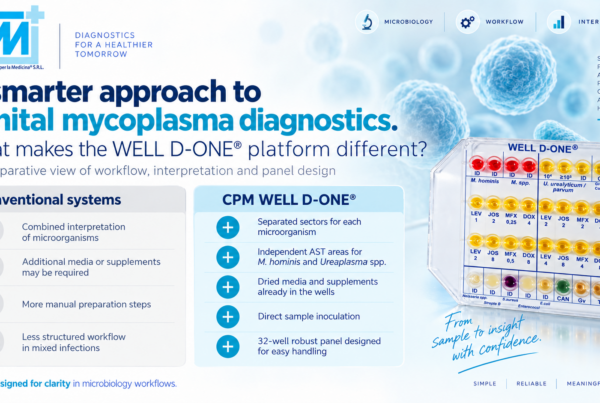
- separated sectors for different microorganisms;
- separate AST areas for Mycoplasma hominis and Ureaplasma spp.;
- dried media and supplements already incorporated into the wells;
- no automatic pipettes required;
- direct sample inoculation according to the relevant instructions for use;
- compatibility, where specified, with COPAN UTM and Liquid Amies;
- a robust panel designed to support straightforward inoculation, incubation and result reading.
Why does microorganism separation matter?
A central feature of the WELL D-ONE systems is the presence of dedicated analytical sectors for individual microorganisms.
This architecture allows the growth of different microorganisms to be assessed separately and, in configurations dedicated to genital mycoplasmas, also provides independent areas for antimicrobial susceptibility screening.
This becomes particularly relevant in mixed infections.
Mycoplasma hominis and Ureaplasma spp. can require different interpretation. WELL D-ONE configurations allow growth and susceptibility results to be evaluated in separate sectors rather than combining different microorganisms within a single analytical result.
Identification and antimicrobial susceptibility screening in one system
WELL D-ONE configurations dedicated to genital mycoplasmas combine organism detection with antimicrobial susceptibility screening.
Depending on the specific product configuration, antibiotic panels may include:
- levofloxacin;
- moxifloxacin;
- tetracyclines or doxycycline;
- clindamycin;
- erythromycin;
- josamycin.
Separate antimicrobial susceptibility areas for M. hominis and Ureaplasma spp. make it possible to consider microorganisms with different susceptibility characteristics and interpretative criteria independently.
Results must always be interpreted according to the specific product instructions for use.
Integrated culture media and supplements
Workflow simplification is another important element of the WELL D-ONE design.
In WELL D-ONE panels, the dried media and supplements required for microorganism growth and identification are already incorporated into the wells.
In the described configurations, this avoids the need to prepare and add separate culture media and growth supplements during test setup.
The system has also been designed to operate without automatic pipettes.
The result is a workflow with fewer preparation steps and a panel architecture intended to simplify routine laboratory handling.
A panel designed for routine laboratory work
WELL D-ONE is characterised not only by its analytical content but also by its physical design.
The rigid 32-well polypropylene panel provides stability during inoculation and result interpretation.
Well depth and spacing are designed to facilitate sample inoculation and help reduce leakage between areas during handling.
Dedicated areas on the panel can also be used to record sample information and notes. Panels can be stacked during incubation, supporting more efficient use of incubator space.
Multiple microorganisms, one platform concept
Depending on the configuration, the WELL D-ONE family can investigate microorganisms beyond Mycoplasma hominis and Ureaplasma spp. that may be relevant in urogenital microbiology.
Different configurations may include organisms such as:
Candida albicans, Candida spp., Gardnerella vaginalis, Trichomonas vaginalis, Neisseria gonorrhoeae, Streptococcus agalactiae, Staphylococcus aureus and Enterococcus.
This makes it possible to select a configuration according to individual laboratory requirements.
Designing diagnostics around laboratory needs
The WELL D-ONE concept starts from a practical question: how can a microbiology test be made easier to manage while preserving the information needed for interpretation?
CPM’s approach combines:
analytical separation, simplified workflows, multiparametric panels and independent microorganism management.
WELL D-ONE® reflects this approach: a family of solutions designed for integration into everyday microbiology laboratory practice.
F.A.Q.
What is WELL D-ONE®?
WELL D-ONE® is a family of CPM microbiology panels designed for microorganism identification and, in selected configurations, antimicrobial susceptibility screening.
How many wells are included in a WELL D-ONE panel?
The described configurations use rigid polypropylene 32-well panels.
Does WELL D-ONE require additional culture media or supplements?
In the described configurations, the dried media and supplements required for microorganism growth and identification are already incorporated into the wells.
Are automatic pipettes required?
No. The described WELL D-ONE systems are designed for use without automatic pipettes.
Can Mycoplasma hominis and Ureaplasma spp. be evaluated separately?
Yes. A distinguishing feature of the dedicated configurations is the presence of separate sectors for microorganism growth and antimicrobial susceptibility screening.
Can WELL D-ONE be used with sample transport media?
The described configurations include compatibility with COPAN UTM and Liquid Amies. Specific conditions should always be checked in the relevant instructions for use.